Showing posts with label tiger. Show all posts

February 15, 2011

Feb 15: Zoo Two

I'm really impressed with Vanessa's images from yesterday. (Click here.)
I can't help but share a few more of my own.

I sold a zoom lens and replaced it with a (less expensive) telephoto.
The zoo was my first test of the new gear.
All of these images are shot at 300mm f/4. I have not cropped any of them.

All of the images are also shot through some form of glass or fencing.

Sometimes it's really obvious and distracting.


And sometimes it's very hard to tell that the animals are in cages. Although, the artificial lighting gives it away. (As do their faces.)


Sometimes I can work around it.


Though this Amur Leopard certainly cannot.


It seems only the birds are free. The local birds at least.


Sometimes the fence adds an interesting dynamic.


While sometimes it just leaves a sour taste in your mouth.


Very sour. But at least my lens is pretty sharp, even at f/4. (blown up for full res.)


The Zoo is a great benefactor to animal species.
But it's not a great place for the individual animals.
It's a rather depressing place actually.


I have mixed feelings.
But I'm very happy with the performance of my new 300mm.
And the last image of the Gorilla was shot at ISO 3200. It's amazing what digital can do.

February 14, 2011

Feb 14: The Zoo

I've enjoyed zoos since I was a little kid, as I have a deep fascination with animals. Today, during a warm spell (58F), Vanessa and I visited the Hogle Zoo in SLC.
Vanessa has also taken an interest in learning more about photography. I'm trying to teach her a few things. Today was a great opportunity to practice.

I won't delve into how I currently feel about captive animals (or 'pets'), but I think some of our images say more than I ever could.

Here are 12 images, 6 from each of us.

Jeremy.


Jeremy.


Vanessa.


Vanessa.


Vanessa.


Vanessa.


Jeremy.


Vanessa.


Jeremy.


Jeremy.


Jeremy.


Vanessa.


Vanessa shot some amazing images. Wow.

December 20, 2010

Dec 20: India Part 6

Recall what an 'average' tiger sighting might be, from a few posts ago.
Just 1 tiger, in the brush, for 30 seconds, with 50 or more people.

Here's what an extraordinary tiger sighting might be.

First, a female.


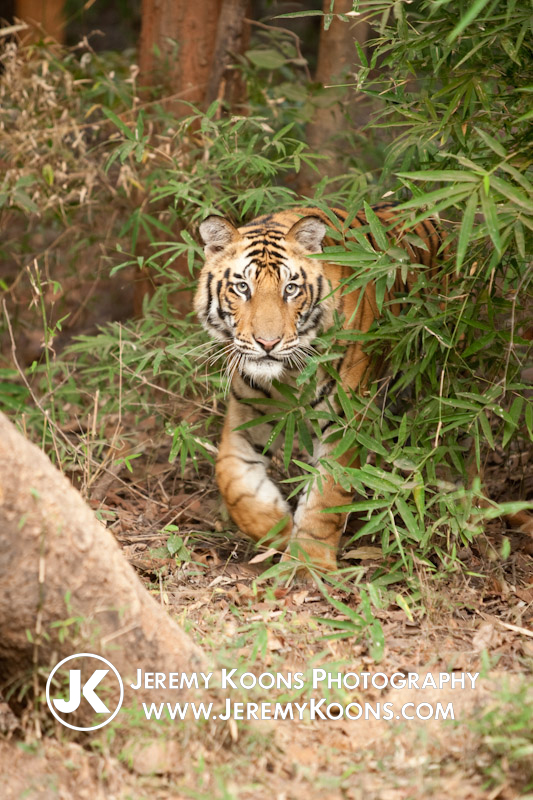
She lays in the road just in front of us.


Maybe 7 meters from the jeep?


Then a male, her brother, emerges. These 'cubs' are ~20 months old, nearly full grown, and soon to become independent.


He marks the tree and has a stretch.


He weighs roughly 200 kilos (over 400 lbs).


The siblings walk leisurely down the road.


As we follow, a second male (another brother) steps out behind us.


We wait for him to cross the road to join the others.


All three drink from the pond, then scamper off into the brush.


Total elapsed time between the first frame and the last: 26 minutes.
Or 1560 seconds, which is a bit longer than 'average.'

December 17, 2010

Dec 17: India Part 3

Ready to see some tigers?
Be patient. Tiger sighting is an exercise in patience and luck. In India, you might call it Karma.

We spent close to 30 hours in the Nat'l Parks exclusively looking for tigers. (We saw many other great things along the way, but tiger was #1 on the shot list.)

I was fortunate to have 3 tiger sightings. One was at over 500 meters, which was exciting, but served mostly as a teaser. One was 'average' and the other was.... indescribable. (You'll see later.)

The following images describe an 'average' tiger sighting.

We travel with forest guards, expert trackers, and experienced naturalists.


We ride in open jeeps, from sunrise to sunset, with a lunch break during the heat of the day.


We search for signs of tiger, from scratches on the trees to pugmarks in the sand. Listening to the deer, monkeys, and birds is also a proven method.


Towards the end of the day.....
A tiger?


Oh $H!t, a TIGER!


Drat! Calm down and fix your exposure! Quick!


No! You missed it!
And.... he's gone.


Total time between the first shot and the last: 27 seconds.
Think about that. 2 days in a jeep for a 30 second view.

Also of note, there were over a dozen other jeeps at this sighting, which is right about 'average.'


The above sighting is a perfect example of what most people might see. Many people see less (as in, zero tigers). A lucky few see more.

I am one of those lucky few.


The last photo was taken during a different sighting. (duh)

Comparing the two sightings:
Average = 1 tiger, walking through the brush, in crappy light, for under 30 seconds, with 50 other people frantically pointing and yelling, jostling for position.

My lucky sighting = 3 tigers, in full view, in gorgeous light, FOR 26 MINUTES!!!!, with only 7 other people quietly shooting and whispering, taking turns, waiting for pristine moments.

I will share more from this lucky sighting, but not yet.
You'll have to wait for it.
Be patient.

September 21, 2010

Sept 21: Tiger Tales

I'm heading to India this fall.
I've been reading books about India: culture, architecture, wildlife etc.
I've taken special interest in reading about Tigers. (It is the year of the tiger, you know.)


A recent passage gripped me.

As the twentieth century draws to a close, an impressively large percentage of the world's most familiar wild animals are facing extinction. The creatures that we introduce our children to at bedtime as part of their initiation into the world -- lion, leopard, rhinoceros, tiger -- will soon exist only in zoos and in the wilderness of the imagination.
No human being will know when the last wild tiger meets its death. Perhaps in some remaining bit of hill forest in northern Burma a hunter will level his sights on the animal he has been seeking for months. Or perhaps in what was once a national park in the heart of Sumatra that last tiger, driven by hunger, will come to the poisoned bait hopefully set out for it. Or in northern India or Nepal that last remaining wild tiger, emaciated and starving, will be hacked to death by a group of local villagers. All that can be said with a minimum of certainty is that this last wild tiger is no mere hypothesis. Though perhaps not yet born, it will exist. And in all likelihood, it will die within the next twenty-five to thirty years.
For those human beings possessing the courage to look unflinchingly, the fate overtaking the world's wild animals presents itself with irresistible clarity. When, within the lifetime of many children living today, the last remnants of these creatures are trapped and gathered together for their own safekeeping and "the good of all humanity," that great nineteenth-century innovation, the zoo, will come into its own at last. In these hugely funded, highly polished institutions, veritable temples, where the ambient environment and physiological functions of the "living treasures" are monitored as carefully as rising and falling shares on the stock exchange, the zoo will become what it was destined to be from its inception -- a place of pilgrimage where human beings gawk in awed stupefaction at the irreplaceable, literally, priceless, living curiosities.
But that era will pass soon enough. Within a certain number of generations the descendants of these last wild animals, weakened, robbed of the riches of their genetic ancestry, will, in spite of every known technological intervention, every genetic advance and development, perish.
But it will be a strangely inconclusive death.
In that not so distant era, on a day like today, a tiger will roam free, stalking its prey with infinite patience through a pristine habitat in which the colors, sights, smells, and sounds are hyper-real and literally perfect. It will crouch, claws set to earth, and charge in a burst of speed, closing in with murderous swiftness for the kill... ... ...
The most perfect of three-dimensional illusions.
A blur of dancing electrons and shifting shadows.
In the awed silence of a darkened room.

Richard Ives. Of Tigers and Men: Entering the Age of Extinction
1996.

If you have an empty feeling, like I do, after reading that, please continue reading another section.

"So I take it," I say, "that you consider the situation in regard to tiger, the situation in Asia as a whole, as rather hopeless."
"You might say that."
"Do people you know agree with you?"
"I think they do."
"Then why don't people just say it? Why does everyone keep beating around the bush?"
He gives me a long thoughtful look and says, "Hope is something that people are very reluctant to give up -- even those who ought to know better. ... In regard to the forests of Asia, in regard to forests everywhere, we are now entering a sort of threshold era. Once the final threshold has been crossed, everything will be different."
"Meaning?"
"Meaning, simply, that when the last tree is felled, when the last wild place is finally conquered, it will become obvious for the first time in the history of our planet what the human species really amounts to."
"And what is that?"
Looking away, he says, "Something sadder, something infinitely more pathetic, than almost anyone has ever imagined."
I stare at him for a moment.


Additional recommendations.
Sy Montgomery. Spell of the Tiger.
Hemanta Mishra / Jim Ottaway Jr. Soul of the Rhino.
Hemanta Mishra. Bones of the Tiger.
Peter Matthiessen. The Snow Leopard.
Joy Adamson. Born Free.
Farley Mowat. Never Cry Wolf.
Craig Childs. The Animal Dialogues.
Dick Pitman. A Wild Life.
Jack Hannah. Jungle Jack.
Benjamin Mee. We Bought a Zoo.